
Main menu

  • Home
  • Content
    • Current
    • Ahead of print
    • Archive
  • Info for
    • Authors
    • Reviewers
  • About Us
    • About the Ochsner Journal
    • Editorial Board
  • More
    • Alerts
    • Feedback
  • Other Publications
    • Ochsner Journal Blog

User menu

  • My alerts
  • Log in

Search

  • Advanced search
Ochsner Journal
  • Other Publications
    • Ochsner Journal Blog
  • My alerts
  • Log in
Ochsner Journal

Advanced Search

  • Home
  • Content
    • Current
    • Ahead of print
    • Archive
  • Info for
    • Authors
    • Reviewers
  • About Us
    • About the Ochsner Journal
    • Editorial Board
  • More
    • Alerts
    • Feedback
Research ArticleORIGINAL RESEARCH
Open Access

The Modified Early Warning Score as a Predictive Tool During Unplanned Surgical Intensive Care Unit Admission

Annandita Kumar, Hussam Ghabra, Fiona Winterbottom, Michael Townsend, Philip Boysen and Bobby D. Nossaman
Ochsner Journal June 2020, 20 (2) 176-181; DOI: https://doi.org/10.31486/toj.19.0057
Annandita Kumar
1University of Queensland Faculty of Medicine, Ochsner Clinical School, New Orleans, LA
MD
  • Find this author on Google Scholar
  • Find this author on PubMed
  • Search for this author on this site
Hussam Ghabra
2Department of Anesthesiology, Ochsner Clinic Foundation, New Orleans, LA
MD
  • Find this author on Google Scholar
  • Find this author on PubMed
  • Search for this author on this site
Fiona Winterbottom
1University of Queensland Faculty of Medicine, Ochsner Clinical School, New Orleans, LA
3Department of Pulmonary/Critical Care, Ochsner Clinic Foundation, New Orleans, LA
DNP, MSN
  • Find this author on Google Scholar
  • Find this author on PubMed
  • Search for this author on this site
Michael Townsend
1University of Queensland Faculty of Medicine, Ochsner Clinical School, New Orleans, LA
4Department of Surgery, Ochsner Clinic Foundation, New Orleans, LA
MD
  • Find this author on Google Scholar
  • Find this author on PubMed
  • Search for this author on this site
Philip Boysen
5Department of Anesthesiology, University of Mississippi School of Medicine, Jackson, MS
MD
  • Find this author on Google Scholar
  • Find this author on PubMed
  • Search for this author on this site
Bobby D. Nossaman
1University of Queensland Faculty of Medicine, Ochsner Clinical School, New Orleans, LA
2Department of Anesthesiology, Ochsner Clinic Foundation, New Orleans, LA
MD
  • Find this author on Google Scholar
  • Find this author on PubMed
  • Search for this author on this site
  • For correspondence: bnossaman{at}ochsner.org
  • Article
  • Figures & Data
  • References
  • Info & Metrics
  • PDF
Loading

Article Figures & Data

Figures

  • Tables
  • Figure.
    • Download figure
    • Open in new tab
    • Download powerpoint
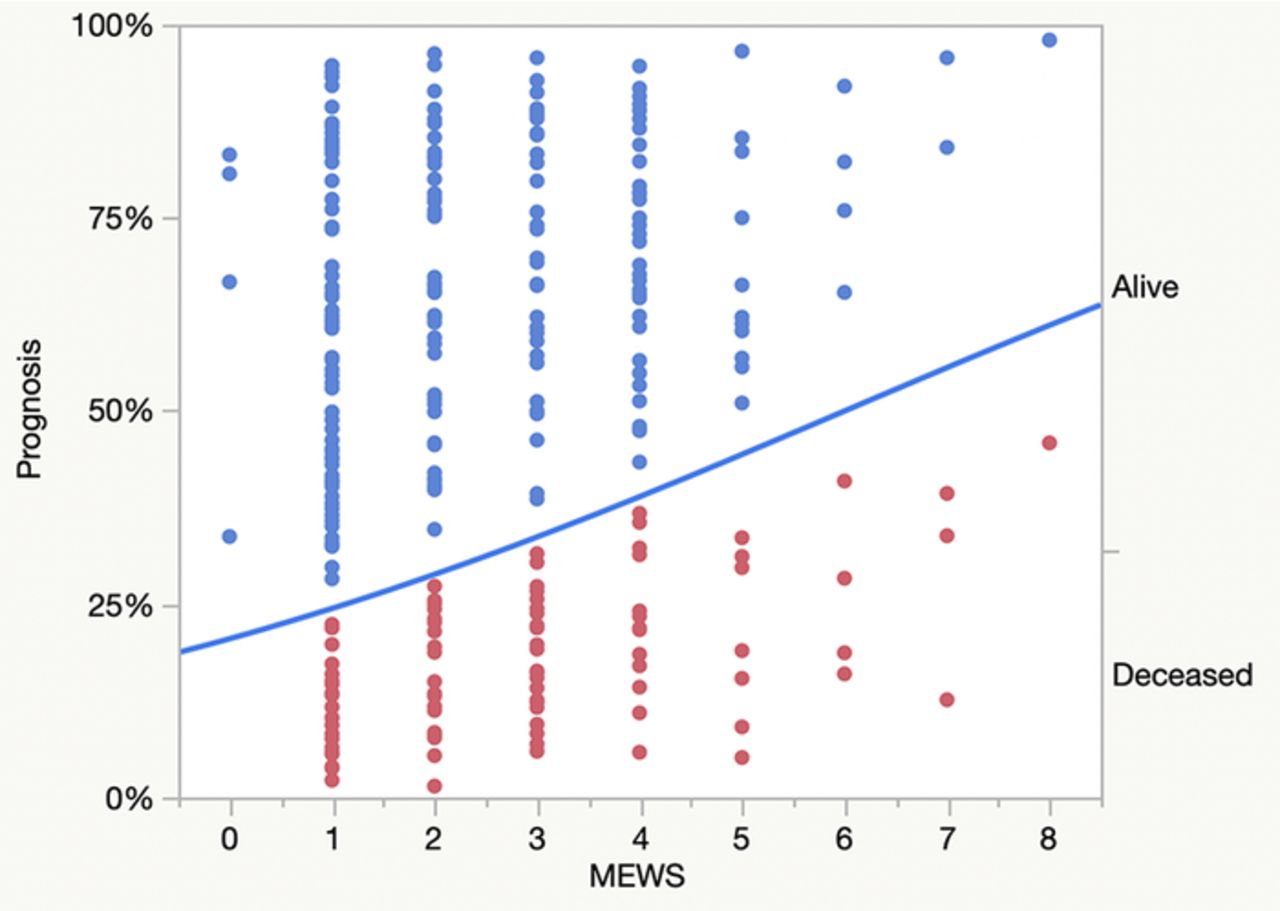
    Figure.

    Association of Modified Early Warning Scores (MEWS) on prognosis during unplanned escalation of care. The line plots the probability of prognosis by MEWS values. Points below the line identify deceased patients. Points above the line identify alive patients. The whole-model statistic is χ2=6.5, P=0.0107; C-index=0.60 (confidence interval [CI] 0.54 to 0.66). Following bootstrapping of the model (1,000 cycles), the whole-model statistic was within the CI range (0.56 to 18.3) of probable population values for this clinical setting.
Tables

  • Figures
    • View popup
    Table 1.

    Demographics and Comorbidities in Patients With Unplanned Escalation of Care

    Bedside VariableAll Patients n=263
    Age, years, median [IQR]61 [50-71]
    Sex, male144 (55)
    Body mass index, kg/m2, median [IQR]26.6 [23.1-33.3]
    Comorbidities
     Systemic hypertension103 (39.2)
     Coronary artery disease44 (16.7)
     History of myocardial infarction10 (3.8)
     Nonsinus dysrhythmias40 (15.2)
     Coronary artery bypass graft11 (4.2)
     Congestive heart failure46 (17.5)
     Peripheral vascular disease56 (21.3)
     Tobacco abuse9 (3.4)
     Chronic obstructive pulmonary disease20 (7.6)
     Reactive airway disease11 (4.2)
     History of cancer24 (9.1)
     Diabetes65 (24.7)
     Chronic liver disease47 (17.9)
     Chronic renal insufficiency49 (18.6)
    • Note: Data are shown as counts (%) unless otherwise indicated; IQR, interquartile range, 25%-75%.

    • View popup
    Table 2.

    Admission Etiologies in Patients With Unplanned Escalation of Care

    EtiologyPercentage of Patients n=263
    Acute lung injury33.2
    Multiple organ dysfunction syndrome22.8
    Gastrointestinal insufficiency17.2
    Myocardial dysfunction9.5
    Vascular insufficiency6.5
    Acute tubular necrosis3.0
    Airway edema2.2
    Postoperative delirium2.2
    Pancreatitis1.3
    Hemorrhage0.9
    Wound infection0.9
    Splenic injury0.4
    • View popup
    Table 3.

    Probabilities, Associated Calculations, and Cross-Classifications for Testing Across Modified Early Warning Scores (MEWS) in Patients With Unplanned Escalation of Care

    MEWSProbability for Mortality, %1–Specificity, %Sensitivity, %Sensitivity – (1–Specificity), %True Positive, nTrue Negative, nFalse Positive, nFalse Negative, n
    856.80.51.30.81185176
    751.51.65.23.64183373
    646.03.89.15.37179770
    540.78.611.73.191701668
    435.625.329.94.6231394754
    330.839.357.117.8*441137333
    226.364.581.817.3636612014
    122.397.91002.17741820
    018.81001000.07701860
    • Note: A cut-point of 3 was calculated in this model based upon the highest percentile value in the Sensitivity – (1–Specificity) column.

    • View popup
    Table 4.

    Confusion Matrix for Modified Early Warning Score During Bedside Evaluation in Unplanned Escalation of Care

    Actual Prognosis
    Predicted PrognosisAliveDeceasedTotals
    Alive183 (a or TP)73 (b or FP)256 (r1)
    Deceased3 (c or FN)4 (d or TN)7 (r2)
    Totals186 (c1)77 (c2)263 (t)
    • ARR, Absolute risk reduction; CI, confidence interval; DP, difference in proportions; FN, false negative; FP, false positive; TN, true negative; TP, true positive.

    • Prevalence=Alive [c1/t]=186/263=0.707 (71%) (CI 0.65 to 0.76); Deceased [c2/t]=77/263=0.293 (29%) (CI 0.241 to 0.35)

    • Kappa=0.049 (CI –0.015 to 0.103).

    • Test statistics not dependent upon prevalence.

    •  Sensitivity=a/c1=183/186=0.984 (CI 0.97 to 0.996)

    •  Specificity=d/c2=4/77=0.052 (CI 0.019 to 0.080)

    •  Positive predictive value=a/r1=183/256=0.715 (CI 0.71 to 0.72)

    •  Negative predictive value=d/r2=4/7=0.571 (CI 0.20 to 0.88)

    •  Positive likelihood ratio=Sensitivity/(1–Specificity)=0.984/(1–0.052)=1.038 (CI 0.99 to 1.08)

    •  Negative likelihood ratio=(1-Sensitivity)/Specificity=(1–0.984)/0.052=0.310 (CI 0.06 to 1.61)

    •  Odds ratio=(a/b)/(c/d)=(183/73)/(3/4)=3.34 (CI 0.61 to 19.4)

    •  Relative risk=(a/r1)/(c/r2)=(183/256)/(3/7)=1.67 (CI 0.89 to 6.08)

    •  Diagnostic odds ratio=[Sensitivity/(1–Sensitivity)]/[(1–Specificity)/Specificity=[0.984/(1–0.984)]/[(1–0.052)/0.052]=3.373 (CI 0.61 to 19.36)

    •  Error odds ratio=[Sensitivity/(1–Sensitivity)]/[Specificity/(1–Specificity)]=(0.984/[1-0.984])/(0.052/[1-0.052])=1,139 (CI 1,711 to 2,553)

    •  Difference in proportions=[(a/r1) – (c/r2)]=[(183/256) – (3/7)]=0.286 (CI –0.09 to 0.60)

    •  Number needed to treat=(1/absolute value of DP) which is equal to (1/absolute value of ARR)=1/0.286=3.49 (CI 1.66 to infinite)

    •  Absolute risk reduction=[(c/r2) – (a/r1)]=[(3/7) – (183/256)]=which is equal to –DP=–0.286 (CI –0.60 to 0.09)

    •  Relative risk reduction=[ARR/(c/r2)]=[–0.286/(3/7)]=–0.668 (CI –5.079 to 0.114)

    •  Youden J value=(Sensitivity+Specificity–1)=(0.984+0.052–1)=0.036 (CI –0.01 to 0.08)

    •  Number needed to diagnose=which is equal to (1/Youden J)=(1/0.036)=27.9 (CI 13.23 to 88.03)

    • Test statistics dependent upon prevalence.

    •  Accuracy=(a+d)/t)=(183+4)/263=0.711 (71%) (CI 0.69 to 0.73)

    •  Misclassification rate=[(c+b)/t]=(3+73)/263=0.289 (29%) (CI 0.27 to 0.31)

    •  Number needed to misdiagnose=[1/(1–Accuracy)]=[1/(1–0.711)]=3.46 (CI 3.24 to 3.67)

PreviousNext
Back to top

In this issue

Ochsner Journal: 20 (2)
Ochsner Journal
Vol. 20, Issue 2
Jun 2020
  • Table of Contents
  • Table of Contents (PDF)
  • About the Cover
  • Index by author
  • Advertising (PDF)
  • Back Matter (PDF)
  • Ed Board (PDF)
  • Front Matter (PDF)
Print
Download PDF
Email Article

Thank you for your interest in spreading the word on Ochsner Journal.

NOTE: We only request your email address so that the person you are recommending the page to knows that you wanted them to see it, and that it is not junk mail. We do not capture any email address.

Enter multiple addresses on separate lines or separate them with commas.
The Modified Early Warning Score as a Predictive Tool During Unplanned Surgical Intensive Care Unit Admission
(Your Name) has sent you a message from Ochsner Journal
(Your Name) thought you would like to see the Ochsner Journal web site.
CAPTCHA
This question is for testing whether or not you are a human visitor and to prevent automated spam submissions.
Citation Tools
The Modified Early Warning Score as a Predictive Tool During Unplanned Surgical Intensive Care Unit Admission
Annandita Kumar, Hussam Ghabra, Fiona Winterbottom, Michael Townsend, Philip Boysen, Bobby D. Nossaman
Ochsner Journal Jun 2020, 20 (2) 176-181; DOI: 10.31486/toj.19.0057

Citation Manager Formats

  • BibTeX
  • Bookends
  • EasyBib
  • EndNote (tagged)
  • EndNote 8 (xml)
  • Medlars
  • Mendeley
  • Papers
  • RefWorks Tagged
  • Ref Manager
  • RIS
  • Zotero
Share
The Modified Early Warning Score as a Predictive Tool During Unplanned Surgical Intensive Care Unit Admission
Annandita Kumar, Hussam Ghabra, Fiona Winterbottom, Michael Townsend, Philip Boysen, Bobby D. Nossaman
Ochsner Journal Jun 2020, 20 (2) 176-181; DOI: 10.31486/toj.19.0057
del.icio.us logo Twitter logo Facebook logo Mendeley logo
  • Tweet Widget
  • Facebook Like
  • Google Plus One

Jump to section

  • Article
    • Abstract
    • INTRODUCTION
    • METHODS
    • RESULTS
    • DISCUSSION
    • CONCLUSION
    • ACKNOWLEDGMENTS
    • REFERENCES
  • Figures & Data
  • References
  • Info & Metrics
  • PDF

Cited By...

  • Improved Sensitivity For Detection Of Clinical Deterioration When Diagnostic Pathology And Patient Trends Are Included In Machine Learning Models
  • User interface approaches implemented with automated patient deterioration surveillance tools: protocol for a scoping review
  • Google Scholar

More in this TOC Section

  • Management and Outcomes of Complications Related to BioZorb Use in Breast-Conserving Surgery: A Retrospective Single-Center Case Series Analysis
  • Short-Term Risk of Complications Related to Obstructive Sleep Apnea After Sinonasal Surgery
  • Effect of Statin Potency on Rapid Coronary Intimal Thickening and Rejection in Heart Transplant Recipients
Show more ORIGINAL RESEARCH

Similar Articles

Keywords

  • Clinical deterioration
  • critical care
  • early warning score
  • mortality
  • predictive value of tests

Our Content

  • Home
  • Current Issue
  • Ahead of Print
  • Archive
  • Featured Contributors
  • Ochsner Journal Blog
  • Archive at PubMed Central

Information & Forms

  • Instructions for Authors
  • Instructions for Reviewers
  • Submission Checklist
  • FAQ
  • License for Publishing-Author Attestation
  • Patient Consent Form
  • Submit a Manuscript

Services & Contacts

  • Permissions
  • Sign up for our electronic table of contents
  • Feedback Form
  • Contact Us

About Us

  • Editorial Board
  • About the Ochsner Journal
  • Ochsner Health
  • University of Queensland-Ochsner Clinical School
  • Alliance of Independent Academic Medical Centers

© 2026 Ochsner Clinic Foundation

Powered by HighWire