
Main menu

  • Home
  • Content
    • Current
    • Ahead of print
    • Archive
  • Info for
    • Authors
    • Reviewers
  • About Us
    • About the Ochsner Journal
    • Editorial Board
  • More
    • Alerts
    • Feedback
  • Other Publications
    • Ochsner Journal Blog

User menu

  • My alerts
  • Log in

Search

  • Advanced search
Ochsner Journal
  • Other Publications
    • Ochsner Journal Blog
  • My alerts
  • Log in
Ochsner Journal

Advanced Search

  • Home
  • Content
    • Current
    • Ahead of print
    • Archive
  • Info for
    • Authors
    • Reviewers
  • About Us
    • About the Ochsner Journal
    • Editorial Board
  • More
    • Alerts
    • Feedback
Research ArticleORIGINAL RESEARCH
Open Access

Impact on an Urgent Care Clinic of a New Freestanding Emergency Department in a Resource-Scarce Area

Diana Hamer, Glenn N. Jones, Michael R. Loewe and Mandi W. Musso
Ochsner Journal September 2022, 22 (3) 211-217; DOI: https://doi.org/10.31486/toj.21.0146
Diana Hamer
1Louisiana State University Health Sciences Center, School of Medicine, Baton Rouge Campus, Baton Rouge, LA
2Division of Academic Affairs, Our Lady of the Lake Regional Medical Center, Baton Rouge, LA
PhD
  • Find this author on Google Scholar
  • Find this author on PubMed
  • Search for this author on this site
  • For correspondence: dhamer{at}nnphi.org
Glenn N. Jones
1Louisiana State University Health Sciences Center, School of Medicine, Baton Rouge Campus, Baton Rouge, LA
PhD
  • Find this author on Google Scholar
  • Find this author on PubMed
  • Search for this author on this site
Michael R. Loewe
1Louisiana State University Health Sciences Center, School of Medicine, Baton Rouge Campus, Baton Rouge, LA
MD
  • Find this author on Google Scholar
  • Find this author on PubMed
  • Search for this author on this site
Mandi W. Musso
1Louisiana State University Health Sciences Center, School of Medicine, Baton Rouge Campus, Baton Rouge, LA
2Division of Academic Affairs, Our Lady of the Lake Regional Medical Center, Baton Rouge, LA
PhD
  • Find this author on Google Scholar
  • Find this author on PubMed
  • Search for this author on this site
  • Article
  • Figures & Data
  • References
  • Info & Metrics
  • PDF
Loading

Article Figures & Data

Figures

  • Tables
  • Figure.
    • Download figure
    • Open in new tab
    • Download powerpoint
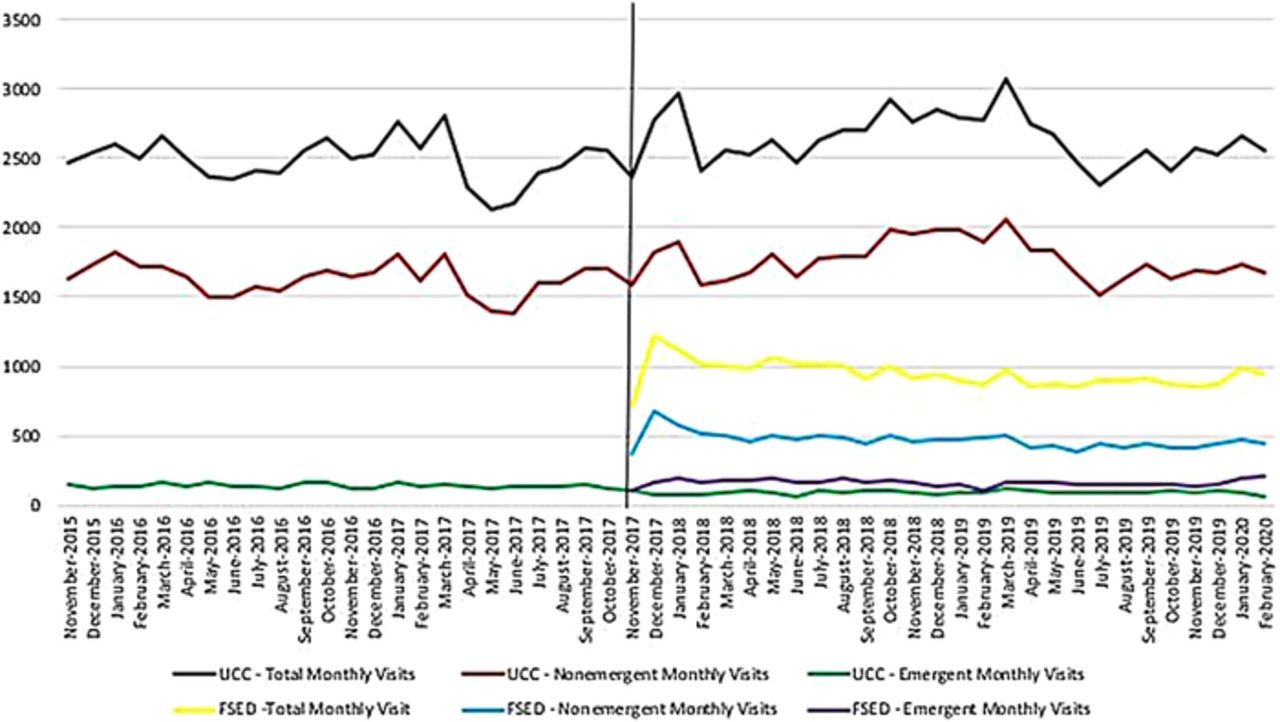
    Figure.

    Monthly visits to the urgent care clinic (UCC) and freestanding emergency department (FSED) by nonemergent and emergent classification.
Tables

  • Figures
    • View popup
    Table 1.

    Demographic Characteristics of Patients Presenting to the Urgent Care Clinic and Freestanding Emergency Department

    Urgent Care Clinic
    VariableBeforeaAfteraP ValueFreestanding Emergency Department
    Number of visits63,48372,61026,458
    Age, years, median (IQR)b36.1 (26.5-50.5)35.1 (25.9-49.8)<0.00141.05 (29.3-56.2)
    Race/ethnicityc
     White/Caucasian5,126 (8.1)4,502 (6.2)<0.0011,951 (7.4)
     Black/African American56,479 (89.0)66,446 (91.5)23,781 (89.9)
     Hispanic648 (1.0)530 (0.7)285 (1.1)
     Asian202 (0.3)163 (0.2)60 (0.2)
     Other1,028 (1.6)969 (1.3)381 (1.4)
    Sexc,d
     Female38,916 (61.3)48,242 (66.4)<0.00115,355 (58.0)
     Male24,563 (38.7)24,363 (33.6)11,103 (42.0)
    Insurance statusc
     Private9,186 (14.5)9,414 (13)<0.0013,497 (13.2)
     Medicaid25,533 (40.2)41,559 (57.2)13,771 (52.0)
     Medicare5,204 (8.2)8,920 (12.3)5,245 (19.8)
     Self-pay23,560 (37.1)12,717 (17.5)3,945 (14.9)
    Emergency department to hospital admission3,387 (12.8)
    • ↵aBefore, 26 months before the opening of the freestanding emergency department (October 1, 2015, to November 15, 2017); After, 28 months after the opening of the freestanding emergency department (November 16, 2017, to March 1, 2020).

    • ↵bMann-Whitney U test comparing the independent distribution of nonparametrically distributed data.

    • ↵cChi-square test of independence.

    • ↵dTotal n for the Before column is 63,479. Total n for the After column is 72,605.

    • Notes: Data are presented as n (%) unless otherwise indicated. P<0.05 indicates statistical significance.

    • IQR, interquartile range.

    • View popup
    Table 2.

    Mean Visits per Month, Emergency Department Outcomes, and AR(1) Model Estimations for Urgent Care Clinic Visits

    Visit Classification/OutcomeBefore,a Mean Visits per MonthAfter,a Mean Visits per MonthEstimatebStandard Errort TestP Value
    Urgent care clinic visits
     Total2,441.651,910.78–120.8870.951.7040.095
     Nonemergent1,603.381,739.3291.8160.341.5210.134
     Emergent138.1188.71–48.373.70–13.059<0.001
    Freestanding emergency department visits
     Total944.92
     Nonemergent477.07
     Emergent163.42
    Freestanding emergency department outcomes
     Discharge823.96
     Hospital admission120.96
    • ↵aBefore, 26 months before the opening of the freestanding emergency department (October 1, 2015, to November 15, 2017); After, 28 months after the opening of the freestanding emergency department (November 16, 2017, to March 1, 2020).

    • ↵bDifference between the mean before the freestanding emergency department opening and the mean after the freestanding emergency department opening after adjusting for autocorrelation. A negative estimate indicates a decrease in visits between the 2 time periods, while a positive estimate indicates an increase.

    • Note: P<0.05 indicates statistical significance.

    • View popup
    Table 3.

    Classification and Severity of Visits to the Freestanding Emergency Department by Urgent Care Clinic Status

    Urgent Care Clinic
    Visit Classification/SeverityOpenaClosedaP Valueb
    Classification
     Nonemergent7,404 (46.8)4,227 (55.6)<0.001
     Emergent3,030 (19.1)869 (11.4)<0.001
     Alcohol/drug251 (1.6)71 (0.9)<0.001
     Psychiatric228 (1.4)84 (1.1)0.040
     Injury1,784 (11.3)1,109 (14.6)<0.001
     Unclassified3,139 (19.8)1,249 (16.4)<0.001
    Emergency severity index
     Immediate – 579 (0.5)27 (0.4)<0.001
     Emergent – 42,218 (14.0)431 (5.7)
     Urgent – 312,393 (78.3)3,476 (45.7)
     Less urgent – 2939 (5.9)3,299 (43.4)
     Nonurgent – 1191 (1.2)373 (4.9)
    • ↵aOpen, 7:00 AM to 12:00 AM; Closed, 12:00 AM to 7:00 AM.

    • ↵bChi-square test of independence for difference between visits during urgent care clinic open and closed hours by individual visit classification and overall emergency severity index.

    • Notes: Because 3,013 patients did not have a documented arrival time, their visits could not be included in the open vs closed analysis (n=23,445). Nineteen additional patients did not have a documented emergency severity index, so these patients were not included in the analysis (n=23,426). Data are presented as n (%). P<0.05 indicates statistical significance.

    • View popup
    Table 4.

    Population, Census Block Groups, and Visits per 1,000 People to the Urgent Care Clinic and Freestanding Emergency Department Overall and by Area Deprivation Index

    Urgent Care Clinic
    VariableAdult Population, 2015Adult Population, 2019Census Block GroupsBefore,a Visits/Visits per 1,000 PeopleAfter,a Visits/Visits per 1,000 PeopleP ValuebFreestanding Emergency Department, Visits/Visits per 1,000 People
    Catchment area945,347963,89754961,122 / 64.668,733 / 71.3<0.00125,444 / 26.4
    Area Deprivation Index quintilec
     1st220,349236,8371083,301 / 15.02,894 / 12.2<0.001883 / 3.7
     2nd227,422236,3851125,300 / 23.34,949 / 20.9<0.0011,634 / 6.9
     3rd186,541186,6531097,904 / 42.48,229 / 44.10.0132,663 / 14.3
     4th158,143157,35510412,859 / 81.314,764 / 93.8<0.0015,117 / 32.5
     5th131,965126,05110631,758 / 240.637,897 / 300.6<0.00115,147 / 120.2
    • ↵aBefore, 26 months before the opening of the freestanding emergency department (October 1, 2015, to November 15, 2017); After, 28 months after the opening of the freestanding emergency department (November 16, 2017, to March 1, 2020).

    • ↵bChi-square test of independence.

    • ↵cNo Area Deprivation Index score was available for 10 neighborhoods in the catchment area.

    • Note: P<0.05 indicates statistical significance.

PreviousNext
Back to top

In this issue

Ochsner Journal: 22 (3)
Ochsner Journal
Vol. 22, Issue 3
Sep 2022
  • Table of Contents
  • Table of Contents (PDF)
  • About the Cover
  • Index by author
  • Advertising (PDF)
  • Back Matter (PDF)
  • Ed Board (PDF)
  • Front Matter (PDF)
Print
Download PDF
Email Article

Thank you for your interest in spreading the word on Ochsner Journal.

NOTE: We only request your email address so that the person you are recommending the page to knows that you wanted them to see it, and that it is not junk mail. We do not capture any email address.

Enter multiple addresses on separate lines or separate them with commas.
Impact on an Urgent Care Clinic of a New Freestanding Emergency Department in a Resource-Scarce Area
(Your Name) has sent you a message from Ochsner Journal
(Your Name) thought you would like to see the Ochsner Journal web site.
CAPTCHA
This question is for testing whether or not you are a human visitor and to prevent automated spam submissions.
Citation Tools
Impact on an Urgent Care Clinic of a New Freestanding Emergency Department in a Resource-Scarce Area
Diana Hamer, Glenn N. Jones, Michael R. Loewe, Mandi W. Musso
Ochsner Journal Sep 2022, 22 (3) 211-217; DOI: 10.31486/toj.21.0146

Citation Manager Formats

  • BibTeX
  • Bookends
  • EasyBib
  • EndNote (tagged)
  • EndNote 8 (xml)
  • Medlars
  • Mendeley
  • Papers
  • RefWorks Tagged
  • Ref Manager
  • RIS
  • Zotero
Share
Impact on an Urgent Care Clinic of a New Freestanding Emergency Department in a Resource-Scarce Area
Diana Hamer, Glenn N. Jones, Michael R. Loewe, Mandi W. Musso
Ochsner Journal Sep 2022, 22 (3) 211-217; DOI: 10.31486/toj.21.0146
del.icio.us logo Twitter logo Facebook logo Mendeley logo
  • Tweet Widget
  • Facebook Like
  • Google Plus One

Jump to section

  • Article
    • Abstract
    • INTRODUCTION
    • METHODS
    • RESULTS
    • DISCUSSION
    • CONCLUSION
    • ACKNOWLEDGMENTS
    • Footnotes
    • REFERENCES
  • Figures & Data
  • References
  • Info & Metrics
  • PDF

Cited By...

  • No citing articles found.
  • Google Scholar

More in this TOC Section

  • Short-Term Risk of Complications Related to Obstructive Sleep Apnea After Sinonasal Surgery
  • Effect of Statin Potency on Rapid Coronary Intimal Thickening and Rejection in Heart Transplant Recipients
  • Examination of Aeroallergen Sensitization Patterns in Southeastern Louisiana
Show more ORIGINAL RESEARCH

Similar Articles

Keywords

  • Emergency department
  • healthcare disparities
  • healthcare utilization
  • urgent care

Our Content

  • Home
  • Current Issue
  • Ahead of Print
  • Archive
  • Featured Contributors
  • Ochsner Journal Blog
  • Archive at PubMed Central

Information & Forms

  • Instructions for Authors
  • Instructions for Reviewers
  • Submission Checklist
  • FAQ
  • License for Publishing-Author Attestation
  • Patient Consent Form
  • Submit a Manuscript

Services & Contacts

  • Permissions
  • Sign up for our electronic table of contents
  • Feedback Form
  • Contact Us

About Us

  • Editorial Board
  • About the Ochsner Journal
  • Ochsner Health
  • University of Queensland-Ochsner Clinical School
  • Alliance of Independent Academic Medical Centers

© 2026 Ochsner Clinic Foundation

Powered by HighWire